

USPS
Ground Advantage
2 to 5 days$11.40
all-in · no surprises
Shipping software for a 3PL should bill per label rather than per client or seat and put every client's orders in one queue, which is how GoatLabels works: pay-as-you-go labels from a prepaid wallet, 13 storefront connectors, bulk CSV import, and a REST label API with no monthly fee.
USPS, UPS, FedEx, and DHL quoted together, from US and Singapore origins, on whatever your clients send you.


 all quoted
Fund a prepaid wallet and spend it label by label across every client you serve.
Shipping software for a 3PL should bill per label, not per client, and put every client's orders in one queue. GoatLabels does that with pay-as-you-go labels from a prepaid wallet, 13 storefront connectors, CSV import with header aliasing, and a REST label API, with USPS, UPS, FedEx, and DHL quoted side by side. The table below sets that against how subscription shipping platforms are typically structured.
| GoatLabels | Subscription shipping platforms | |
|---|---|---|
| How the software is billed | Pay-as-you-go labels from a prepaid wallet. No monthly fee, so a client you onboard next quarter costs nothing until their first label prints. | Usually a monthly subscription tiered by shipment count or user seats — check the vendor's pricing page for the current tiers. |
| Getting a client's orders in | 13 live connectors (Shopify, WooCommerce, Amazon, eBay, TikTok Shop, Etsy, Walmart, BigCommerce, Squarespace, Wix, Square, Magento, Temu) plus bulk CSV import and a REST API. | Connector coverage varies by vendor and by plan tier; some channels sit behind a higher plan. |
| Where the orders land | One To Ship queue across every client and channel. The floor works one list, not one tab per brand. | Often one workspace per store or per client, each with its own queue and settings. |
| Client files that never match | CSV import with header aliasing: a column called Ship To Name, Recipient, or Customer all map to the same field without a per-client template. | Typically a saved mapping per file layout that someone maintains as clients change their exports. |
| Carriers on one screen | USPS, UPS, FedEx, and DHL quoted side by side on every parcel, from US or Singapore origins. | Multi-carrier lists are common; which carriers and which origin countries depend on the vendor. |
| Printing at the pack station | Auto-print through PrintNode or the browser, so the label is on the thermal printer before the box is taped. | Print workflows vary; some require a desktop agent or a specific printer integration. |
The right-hand column describes common patterns, not any one vendor. Plans, fees, and connector lists change — compare against each vendor's current pricing page before you decide.
A 3PL wins and loses clients on a monthly cadence, and a seat-based or shipment-tiered subscription charges for the peak before the peak exists. Pay-as-you-go labels from a prepaid wallet mean the bill tracks what actually left the dock, and the wallet balance is one line item you can allocate back to clients.
Pickers do not care which brand an order belongs to; they care what ships before the carrier pickup. Every connector, CSV drop, and API call lands in the same To Ship queue, so the floor sorts by pickup time, service, and zone rather than by tab.
Most 3PLs already have a warehouse system that knows the order, the bin, and the box. A REST label API with one Bearer header lets that system request the rate and the label itself, and auto-print via PrintNode drops it at the station without a human copying anything across.
Connect a Shopify, WooCommerce, Amazon, eBay, TikTok Shop, Etsy, Walmart, BigCommerce, Squarespace, Wix, Square, Magento, or Temu store and its orders land in the To Ship queue. Orders that arrive as a spreadsheet come in through bulk CSV import, where header aliasing maps whatever the sender called each column. Orders that arrive as a message or a screenshot go to the AI assistant, which drafts the label for you to confirm. Every label is rate-shopped across USPS, UPS, FedEx, and DHL, paid from a prepaid wallet with no monthly fee, and auto-printed through PrintNode or the browser at the station that needs it.
Rush order: 3x cartons (12 lb) to Maya R., Austin, TX 78701 — needs to go today
13 connectors, bulk CSV with header aliasing, the REST API, and pasted orders — one To Ship queue.

Auto-print via PrintNode or the browser. Tracking is pushed back to the connected store when the label prints.
Shopify, WooCommerce, Amazon, eBay, TikTok Shop, Etsy, Walmart, BigCommerce, Squarespace, Wix, Square, Magento, and Temu sync into To Ship and get tracking pushed back when you print. Orders that never lived in a storefront — a spreadsheet from a client, a call from a WMS, a pasted email — go into the same queue by CSV import, the REST API, or the AI assistant.
 Shopify
 Etsy
Etsy WooCommerce
 TikTok Shop
 Amazon
 eBay
eBay Squarespace
 Wix
Wix WalmartShopify PlusSoon
 Square
 BigCommerce
 Magento
 ZapierSoon
 NetSuiteSoon
 EcwidSoon
 Temu
Temu SheinSoon
 ChannelAdvisorSoon
 SkuVaultSoon
 Zoho InventorySoon
 Patreon
Moving a label engine should not cost you the carriers, the store sync, or the API. Those all come with you. What does not come with you is a monthly fee sized to your peak month — and what is new is an assistant that turns an unstructured order into a drafted label.
Fund the wallet and every label is a pay-as-you-go debit against it. There is no monthly fee and no plan tier to clear, so the balance you fund is the only number to reconcile at month end.
An email from a client, a screenshot of a form, or a spoken address is not an order record. The AI assistant reads it and drafts the whole label — recipient, parcel, and service — for you to confirm.
Fund the wallet, pay for each label as you go, and pay nothing in a month with no shipments. Volume is never a gate you clear before a label will print.
Live rates from USPS, UPS, FedEx, and DHL side by side, from US and Singapore origins, on every parcel. That is the honest carrier list; if you need one outside it, a broader network is the reason to stay elsewhere. Thirteen storefront connectors sync into To Ship and push tracking back when you print, but a connector is never a prerequisite.
UPS$12.48FedEx$13.22DHL$14.10USPS$11.79REST and JSON with one Bearer header. Create the shipment, compare rates, buy the label, and auto-print it via PrintNode — the dashboard and the API spend the same prepaid balance.
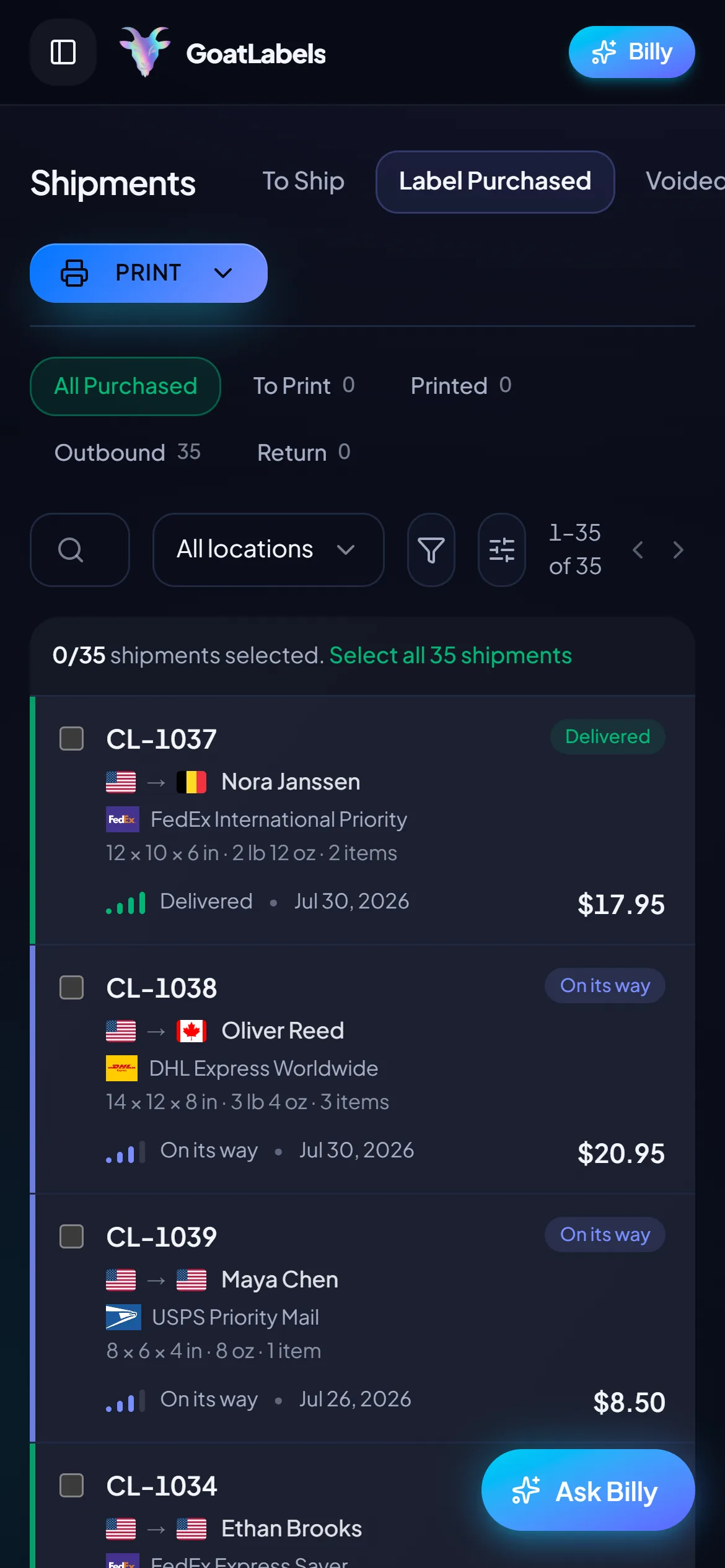
Label ready
CL-1038 · Brooklyn, NY
Subscription platforms expect the order to already exist somewhere they can read. When it arrives as a message, you become the integration — retyping a name, an address, and a weight into a laptop you are not sitting at. GoatLabels takes the message itself, on the phone that is already at the pack station.
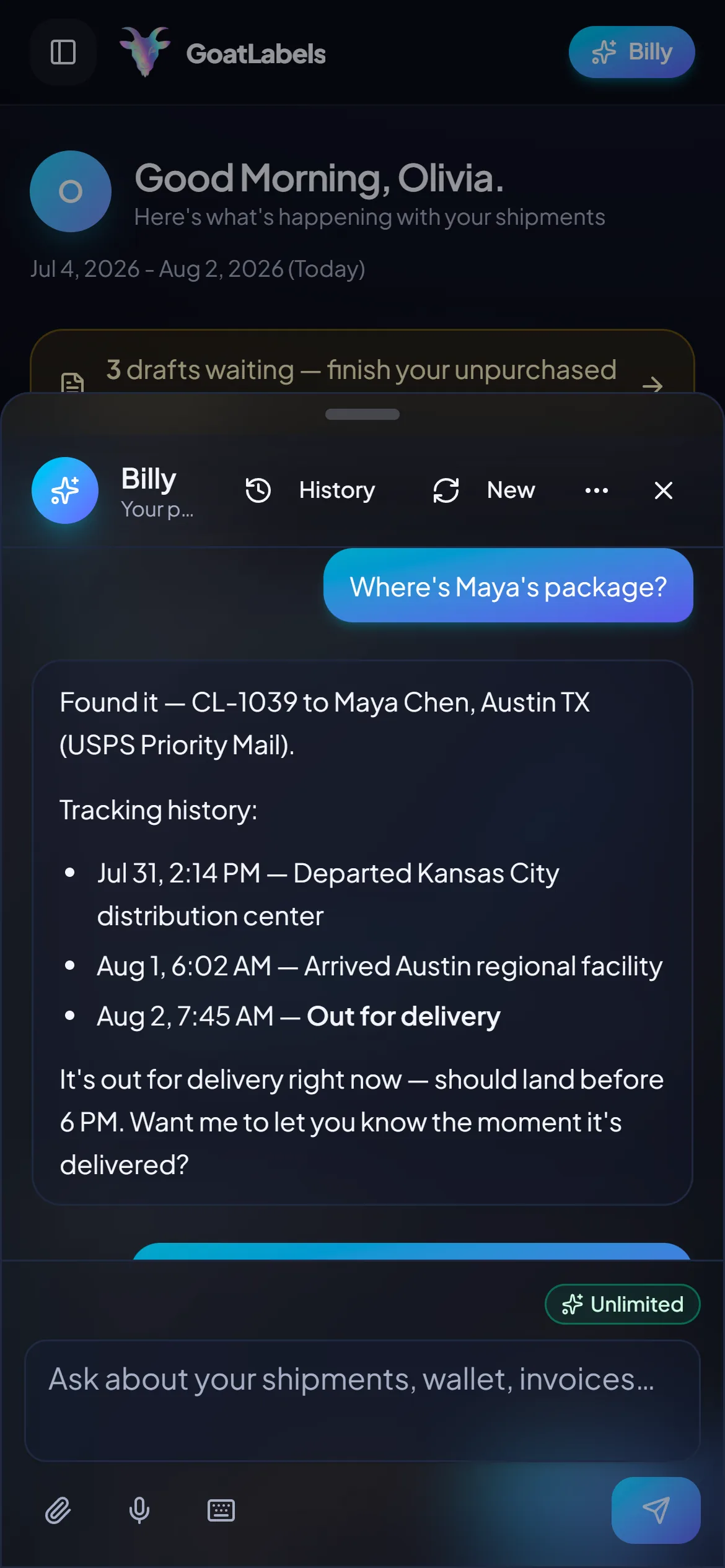
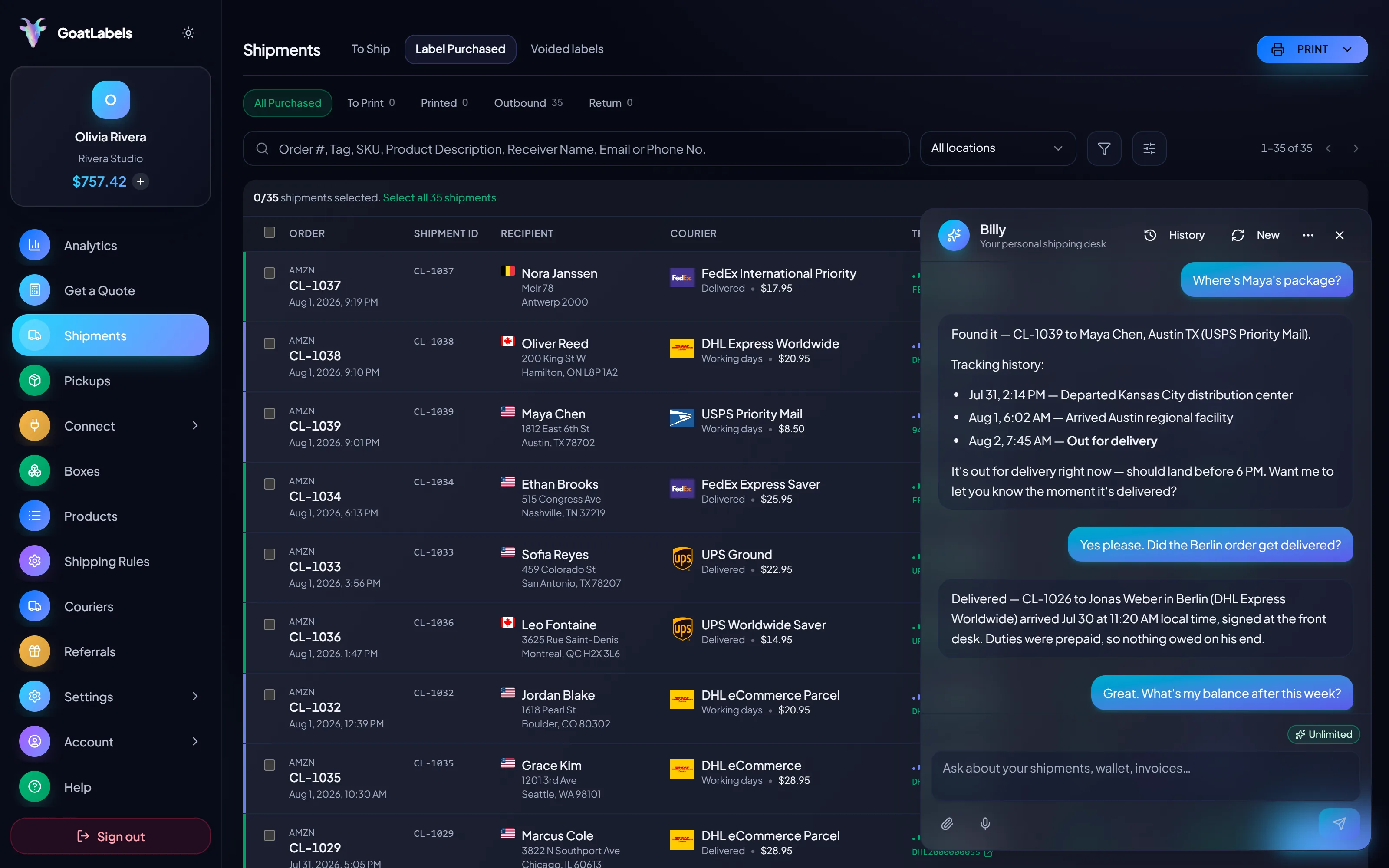
Packing is a two-hands job, and most software's answer is a form. Hold the mic, say who the parcel is going to, and the assistant drafts the label, rate-shops USPS, UPS, FedEx, and DHL, and queues it against your prepaid balance — then answers for it afterwards when a client asks where the parcel is. This is the real product, not a render.
Listening
"Where's the Austin rush order?"
Out for delivery
CL-1039 · Austin, TX · by 6 PM
Plain English in — names, addresses, weights, carriers, services · nothing to import and nothing to map · reads the rate back before a cent leaves the wallet · phone or browser.
Carriers quoted on the same parcel, each a number that is the exact amount leaving your prepaid balance. Nothing is added on the way through, and nothing has to be reconciled against a subscription invoice at month end. Figures are illustrative.
Ground Advantage
2 to 5 days$11.40
all-in · no surprises
Ground
1 to 5 days$9.85
all-in · no surprises
Ground
1 to 5 days$11.20
all-in · no surprises
A warehouse system already knows the order, the bin, and the box. REST, JSON, and one Bearer header let it request the rate and the label directly, and auto-print via PrintNode puts the result at the station. The dashboard and the API buy from the same prepaid balance.
POST /api/v1/shipments
Authorization: Bearer sk_live_…
Idempotency-Key: ord_8421

{
  "to": { "name": "Joyce", "city": "Berlin", "country": "DE" },
  "parcel": { "weight": 2.6, "weight_unit": "lb" },
  "service": "fedex_intl_priority"
}
Labels are pay-as-you-go from a prepaid wallet, with no monthly fee. The 13 connectors, bulk CSV import, the REST API, auto-print, and the AI assistant all sit underneath that. Nothing is a minimum you clear before a label prints.
Volume pricing
illustrativepay for labels, not for seats
$0 / forever
Enough to run an operation through a slow quarter without a subscription under it.
The AI assistant that reads an email, a screenshot, or a voice note into a drafted label is part of the product, not an add-on.
GET /api/v1/shipments
200 OK · plan: free
One Bearer header. The same wallet as the dashboard.
Put a real parcel through and compare the side-by-side rate against what that label costs you on
ShippoPirate ShipShipStationLabel prices are quoted live from USPS, UPS, FedEx, and DHL and shown as one number — the same number that leaves your wallet. Other vendors' plans and fees move, so compare against their current pricing page rather than a figure on ours. Full pricing details
These are the teams for whom pay-as-you-go labels, one queue, and a label API add up to a real difference. The operations that should stay put are named on this page too.
Clients come and go monthly
Volume that arrives per client fits a prepaid wallet better than a seat count. Onboard a client, connect their store, and pay for their labels only when they ship.
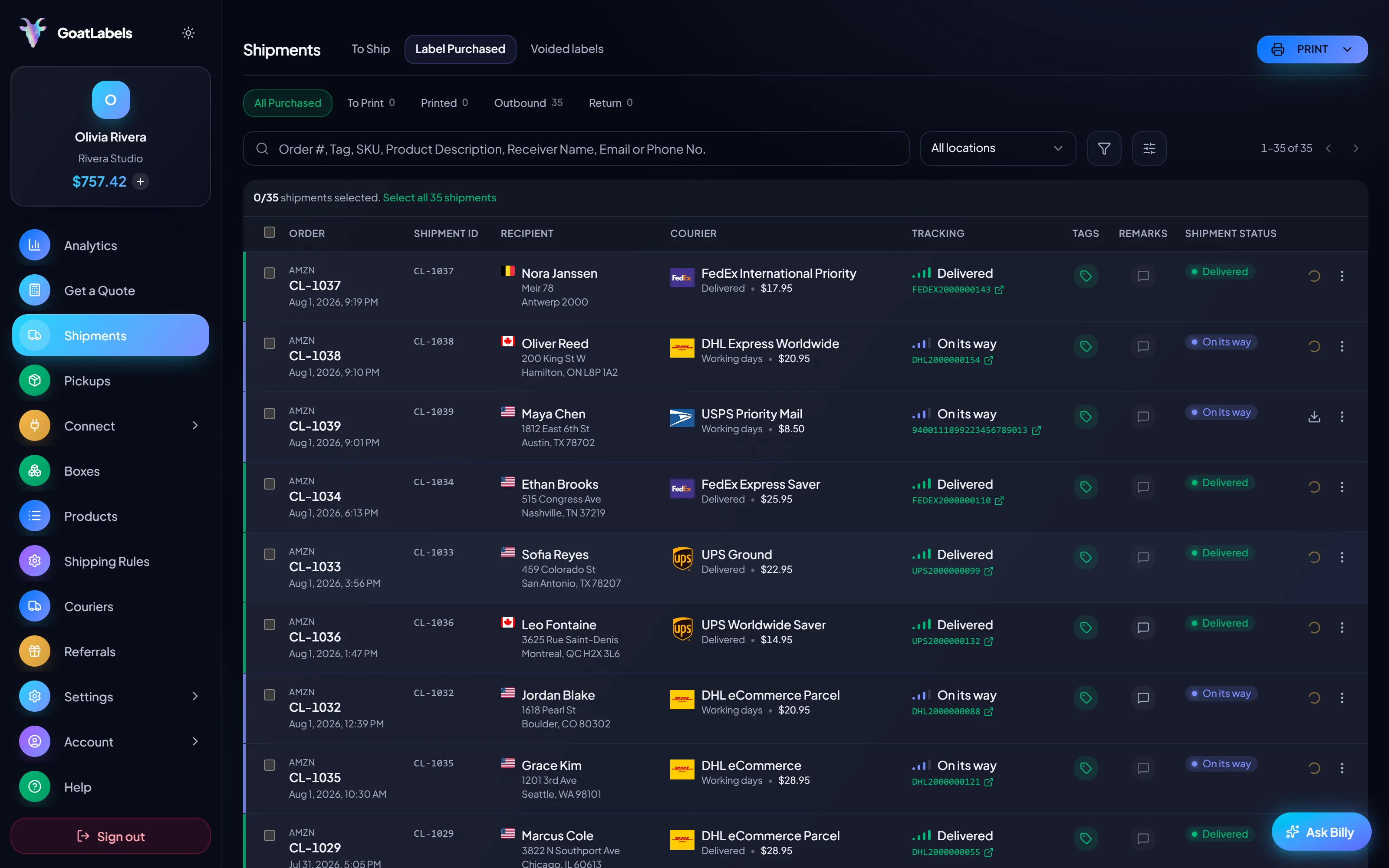
REST API, one Bearer header
Let the warehouse system request the rate and the label, and auto-print the result at the station through PrintNode. Nothing is retyped between the two.
One queue, connector or not
Order #1024 · created via API
The orders that never became a record
13 connectors, one balance
1
wallet behind every store and the API
A video took off and I had 80 TikTok Shop orders by morning. I printed every label from my phone on the bus to the post office.
Early customer · TikTok
TikTok Shop seller
I run my Etsy shop from the kitchen. The AI reads the order, picks the carrier, the label prints. That's the whole workflow now.
Early customer · Etsy
Etsy maker
The API is what every shipping API pretends to be. Idempotency that actually works.
Sasha R.
Staff engineer, marketplace
Related reading:warehouse shipping labels, high-volume labels without a subscription, the shipping API for developers, bulk shipping labels from CSV, the best 3PL shipping software compared, enterprise shipping software compared, B2B shipping software, multi-location shipping software, parcel spend per client.
Fund a prepaid wallet, put through the next order you would have shipped anyway, and compare the side-by-side USPS, UPS, FedEx, and DHL rate against what that label costs you today.
No card required. No contract. No monthly fee.