

USPS
Ground Advantage
2–5 days$7.40
$1.20 of Premium insurance included
all-in · modifiers already folded in
A shipping rate is a lookup: service, times billable weight tier, times zone — the distance band between origin and destination ZIPs — plus modifiers for the address, the season, and your account. Two sellers pay different totals for the same box because they enter that lookup at different rate tiers.
USPS, UPS, FedEx, and DHL each run their own lookup on your parcel — the same weight and zone land in four different cells, which is the whole reason comparing pays.


 4 lookups
Labels here are priced at commercial tiers and paid from a prepaid wallet — card, Apple Pay, Google Pay, ACH, or crypto — as one all-in number.
Strip every complication away and a shipping rate is a table lookup. Each carrier maintains a matrix per service: rows are weight tiers, columns are zones, and the cell where your parcel's row meets its column is the base price. Three inputs select the cell. The service is your choice. The weight tier is the bracket your parcel's billable weight falls into — note tier, not weight, because a parcel two ounces into the next bracket pays the whole bracket. And the zone is the distance band between where the parcel starts and where it ends up.
The tier detail is worth pausing on, because it is the first place sellers can act on this page. Rates do not slope smoothly with weight; they step. Shaving a parcel from just over a bracket boundary to just under it — lighter box, less void fill — buys the previous cell of the matrix, and that saving repeats on every parcel of that shape you ever ship. Which weight the lookup actually uses is its own subject: carriers bill the greater of actual and dimensional weight, andthe package size and weight limits pageowns the divisors, the thresholds, and the measuring technique.
Zones are how carriers turn geography into a column index. Rather than pricing every ZIP-to-ZIP pair, each carrier groups distances into bands — nearby destinations in the low zones, cross-country in the high ones — and publishes a chart keyed to the origin. That wordorigin is the part most explanations skip: zones are relative. There is no such thing as an address that is simply zone 7; it is zone 7 from you. A seller in Ohio and a seller in Oregon shipping to the same buyer in Georgia are reading different columns of the same matrix, and their costs differ before either has chosen a box.
Two practical consequences follow. First, averages lie: your true shipping cost depends on where your buyers cluster relative to you, which is why two shops with identical products and boxes can have structurally different shipping economics. Second, zone spread is a comparison lever — carriers do not step their prices across zones identically, so the cheapest carrier in zone 2 is frequently not the cheapest in zone 8. Quoting all four carriers per parcel is how you make the zone work for you instead of merely happening to you, and the carrier-by-carrier crossover mechanics live onthe cheapest ground shipping services page.
The base cell is where the price starts, not where it ends. On top of it land modifiers, and they sort cleanly into three families. Address modifiers depend on where the parcel lands: a residential destination, a harder-to-reach delivery area, the classification the carrier assigns to the exact address on the label. Seasonal modifiers are calendar-driven: during peak periods carriers switch on temporary per-parcel fees between published dates, and the same label costs more in December than in May. Account modifiers depend on who is asking — fuel-linked percentages, minimums, and the discounts attached to the account doing the buying. The trigger-by-trigger detail isthe shipping surcharges page'sterritory; what matters here is the shape. A modifier is not a penalty — it is a priced fact about the delivery. The failure mode is only ever learning about it after the sale.
This is also why a quoted-at-purchase, all-in price and a rate card give such different impressions of the same carrier. The rate card shows base cells; the delivery includes the facts. A live quote that resolves the address, applies the calendar, and folds in the account-level percentages is showing you the finished number the rate card cannot.
Everything above — the matrix, the zone, the modifiers — exists at least twice, because carriers publish parallel price levels for the same physical service. The retail tier is what a walk-up customer pays at the counter. Commercial tiers are what accounts, platforms, and resellers pay, and they are lower because the carrier's cost of acquiring that parcel is lower. Nothing about the box, the route, or the delivery van changes. The only variable is which tier the buyer of the label entered the lookup at, and that single fact is the largest controllable gap in small-parcel shipping.
The gap is also the easiest one to close, because tier access no longer requires volume. A label bought through a platform that passes commercial tiers through is priced at those tiers from the first parcel — no carrier account, no negotiation, no minimum. That is precisely what GoatLabels does across USPS, UPS, FedEx, and DHL, with the result shown as one all-in figure; the broader economics of buying labels this way live onthe cheap shipping labels page. The table below makes the whole page concrete by decomposing one real parcel at both tiers, side by side.
| Rate component | Retail tier | Commercial tier | What is happening |
|---|---|---|---|
| Base lookup: ground service, 3 lb tier, zone 5 | $12.75 | $9.10 | Same cell of the same matrix — service by weight tier by zone — read at two different tiers. |
| Destination modifier: residential delivery | included | $0.00–$5.55 | Postal-network services price residential in; UPS and FedEx add it as a line item, so the badge on the address matters. |
| Seasonal modifier (off-peak on the verification date) | $0.00 | $0.00 | Zero for most of the year, then switched on between published dates in the fourth quarter. |
| Account modifier: fuel-linked percentage | included | included in quote | Indexed weekly by the express carriers; a live quote folds it in, a printed rate card cannot. |
Worked example — one 3 lb, zone-5 ground parcel, decomposed at both tiers.The figures above are illustrative of a mid-2026 ground shipment and exist to show the shape of the decomposition, not to be your quote: every carrier revises its matrices at least annually and its fuel-linked percentages far more often, and your parcel selects different cells. Verified against the carriers' published retail and commercial rate charts on 2026-08-15; re-checked at each carrier's annual rate announcement by the named marketing owner recorded with this page. For a current number, quote your real parcel — it takes less time than reading a rate card.
Everything this page decomposes happens in the seconds between an order arriving and a price appearing. The packed parcel supplies the weight tier, your origin and the buyer's ZIP supply the zone, the validated address supplies the delivery category, the calendar supplies whatever seasonal component is open, and the account level decides which tier the lookup is read at. Four carriers run that whole sequence in parallel and hand back one all-in figure each.
Shipping to 214 Ridgeline Rd — it is a house, not a shop, if that changes anything.
Zones are relative to where you ship from, so the same destination is a different column for a different seller. That lookup happens for you the moment the destination is known — there is no chart to keep on the wall.

A rate card shows base cells; a quote shows the finished price. The exact quoted amount leaves your balance, and a carrier reweigh — the one thing that can still move afterwards — posts as its own ledger entry rather than an unexplained difference.
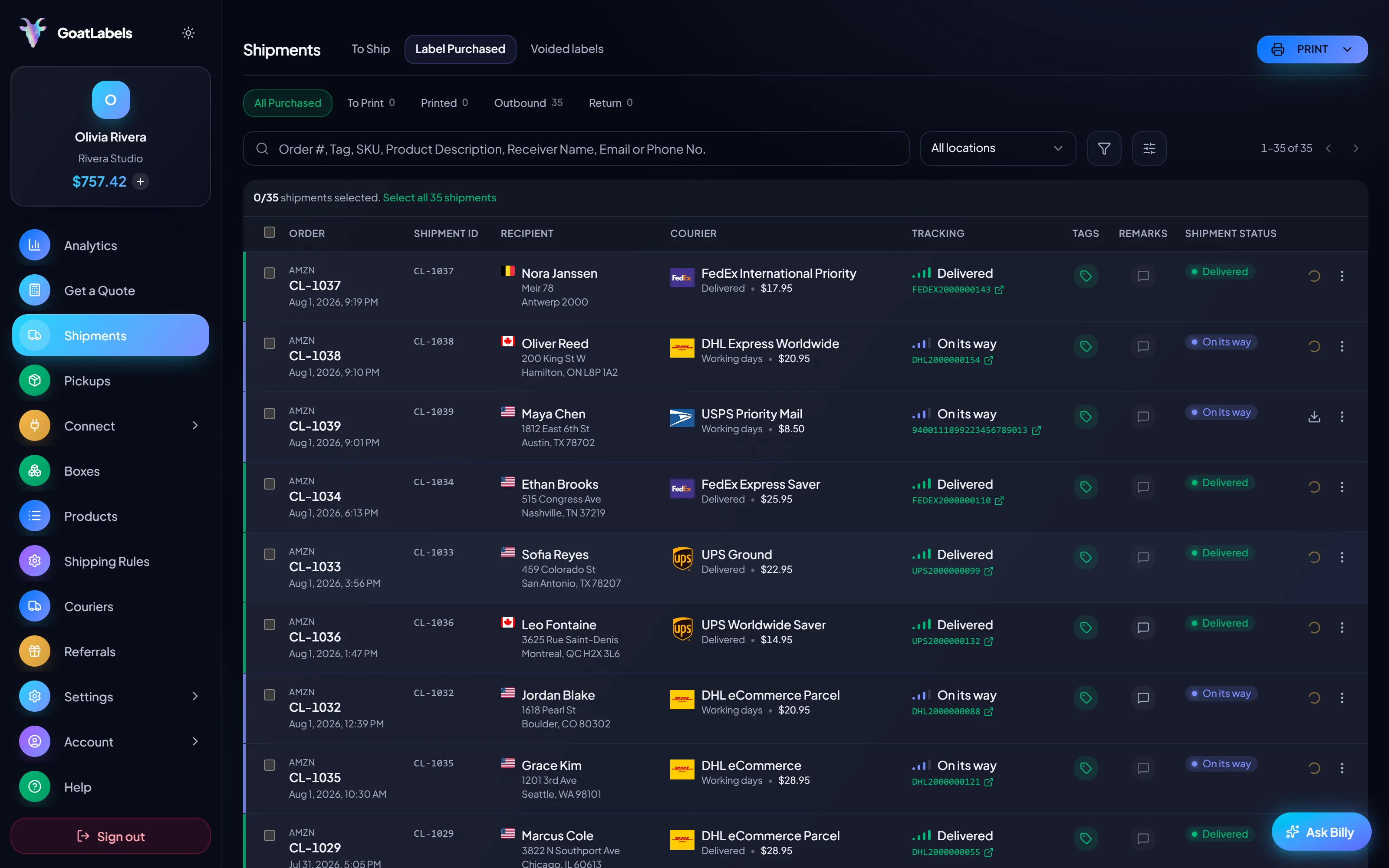
Shopify, Etsy, WooCommerce, and TikTok Shop sync into the To Ship queue, and every order is priced by the same lookup: your origin against the buyer's ZIP, the packed parcel's weight tier, the delivery category on the validated address. A platform's own shipping tab may show you a different number, but it is reading a different tier — not a different distance.
 Shopify
 Etsy
Etsy WooCommerce
 TikTok Shop
 Amazon
 eBay
eBay Squarespace
 Wix
Wix WalmartShopify PlusSoon
 Square
 BigCommerce
 Magento
 ZapierSoon
 NetSuiteSoon
 EcwidSoon
 Temu
Temu SheinSoon
 ChannelAdvisorSoon
 SkuVaultSoon
 Zoho InventorySoon
 Patreon
Everything this page decomposes — tier, zone, modifiers, account level — is folded into one all-in figure per carrier before you pay a cent.
One prepaid wallet, funded by card, Apple Pay, Google Pay, ACH, or crypto, is charged exactly the all-in number you saw at quote time. Every label is its own ledger line, so your real cost per parcel — base plus every modifier — is a fact you can read, not an average you reconstruct from invoices.
Because address modifiers hinge on classification, the destination is validated at quote time and badged residential or commercial before payment. The rate you compare carriers on is computed against the delivery category the carrier will actually apply — not against a guess that gets corrected later.
Labels are priced at commercial tiers across all four carriers with no monthly minimum to print — the tier gap this page describes is closed by default, whether you ship two parcels a month or two hundred a night.
USPS, UPS, FedEx, and DHL each run their own lookup on the same weight, dimensions, and destination, and the four finished prices sit next to their delivery windows. The carrier that wins zone 2 rarely wins zone 8 — with four columns on screen, that stops mattering.
UPS$12.48FedEx$13.22DHL$14.10USPS$11.79The same quote engine is a REST call: send the parcel and destination, get every carrier's all-in figure back in JSON. Unlimited calls on every plan, with signed webhooks for what happens after purchase.
Four lookups done
CL-1051 · zone resolved from your origin
Nobody cross-references four zone charts standing at a packing table, and nobody should have to. Weigh the packed box, confirm the destination, and read four finished prices with their delivery windows next to them — the entire decomposition on this page, resolved at the moment you actually need it.
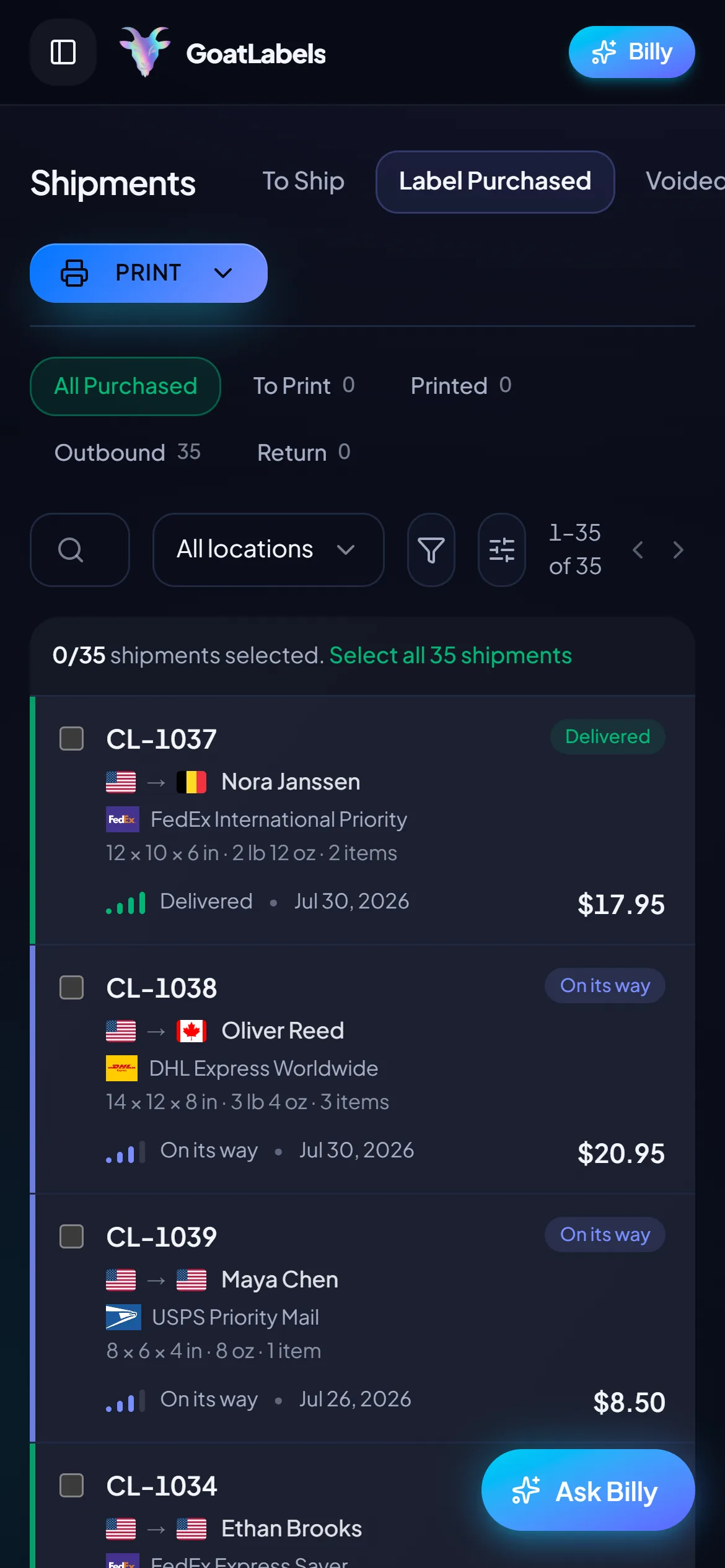
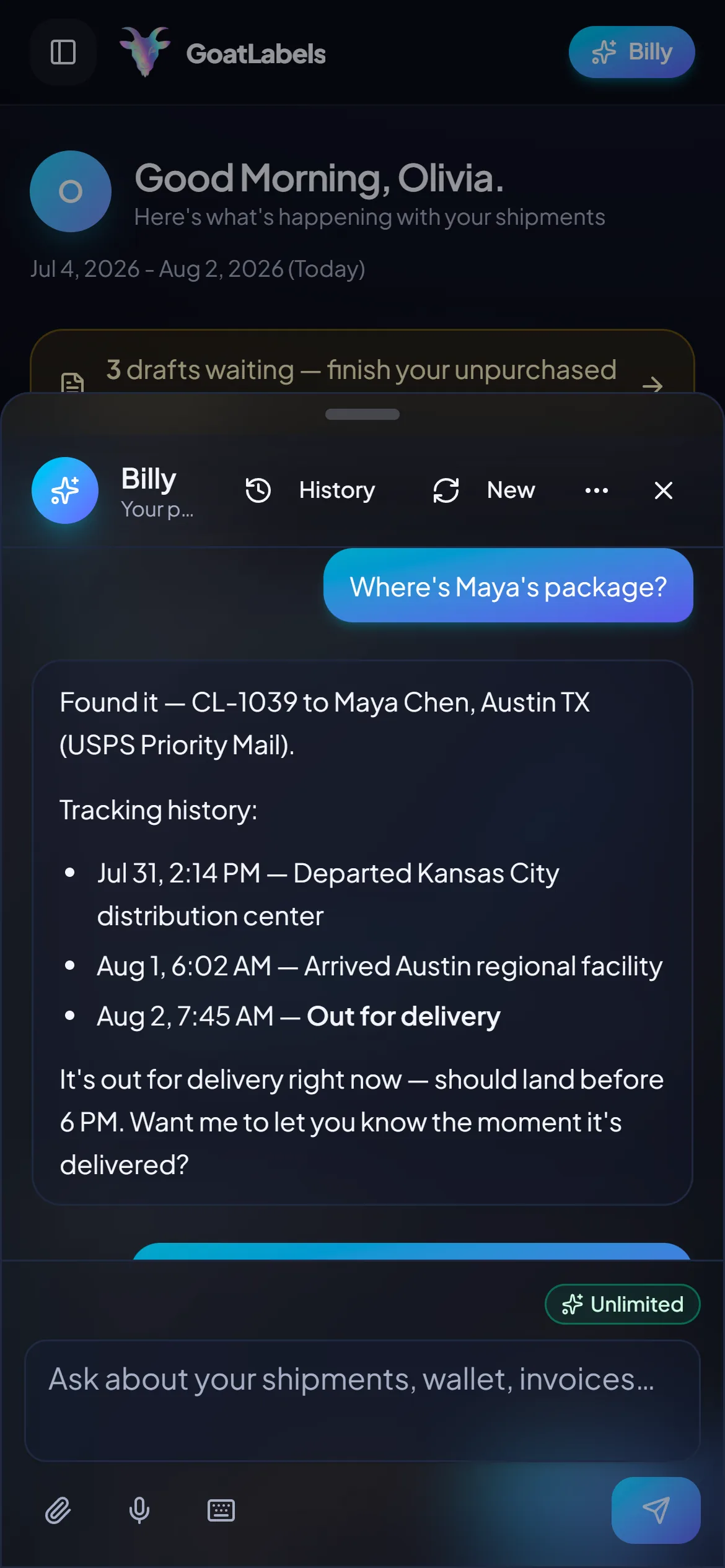
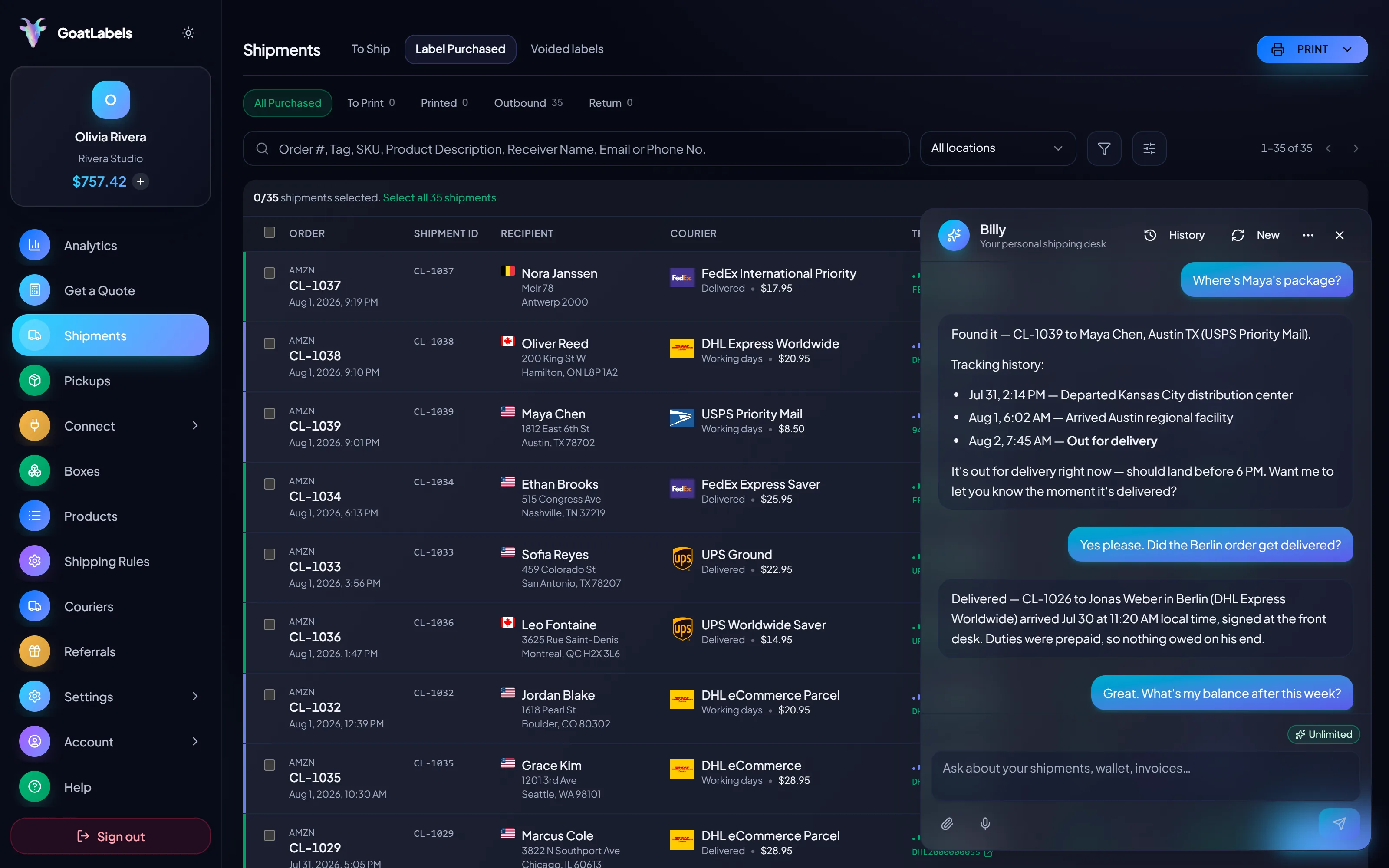
Reading a rate matrix out loud is nobody's idea of a workflow. Hold the mic, say what the parcel weighs and where it is going, and Billy resolves the zone from your origin, validates and classifies the destination, and reads back what each of the four carriers comes to as a single all-in number. It remembers your saved box sizes, so the weight tier is chosen from a real measurement rather than a guess. Included on every plan. This is the real product, not a render.
Listening
"What does the packed box come to going to Austin?"
Out for delivery
CL-1051 · Austin, TX · commercial tier
Speaks plain English · resolves the zone from your origin ZIP · reads four all-in numbers back · included on every plan, never a pricier tier.
Each carrier runs its own matrix, so identical weight and identical distance still produce different prices and different delivery windows. These columns show finished figures — base cell, zone, and every applicable modifier already folded in — and the column you pick is what leaves your prepaid balance. Figures are illustrative, in the same register as the worked decomposition above; quote your real parcel for a current number.
Ground Advantage
2–5 days$7.40
$1.20 of Premium insurance included
all-in · modifiers already folded in
Ground
3–4 days$10.80
$1.20 of Premium insurance included
all-in · modifiers already folded in
Home Delivery
2–4 days$11.40
$1.20 of Premium insurance included
all-in · modifiers already folded in
Everything this page explains — tier, zone, address classification, seasonal and account modifiers — collapses into a single quote call that returns four finished numbers. Compare them in code, pick a winner per parcel, and buy with the same key. Unlimited calls on every plan.
POST /api/v1/shipments
Authorization: Bearer sk_live_…
Idempotency-Key: ord_8421

{
  "to": { "name": "Joyce", "city": "Berlin", "country": "DE" },
  "parcel": { "weight": 2.6, "weight_unit": "lb" },
  "service": "fedex_intl_priority"
}
The largest controllable gap on this page is which tier the lookup is read at, and closing it used to take volume, an account, and a negotiation. Free covers 50 shipments a month at commercial-tier pricing across all four carriers; Pro is a flat monthly plan with unlimited shipments and cheaper label pricing on top of that.
Volume pricing
illustrativemore volume → lower per-label rates
$0 / forever
Read the matrix at commercial tiers from the very first parcel, and owe nothing in a quiet month.
The assistant that turns a pasted order into a quoted parcel — weight, dimensions, validated destination, four lookups — runs unlimited in the web app on Free. Pro adds Billy on Telegram.
GET /api/v1/shipments
200 OK · plan: free
Unlimited calls on Free — still unlimited on Pro.
On Pro we will work with you to beat the label rates you are already getting from
ShippoPirate ShipShipStationEvery price here is quoted live from USPS, UPS, FedEx, and DHL as one all-in number with the applicable modifiers already inside it, and that exact amount leaves your prepaid balance. Carriers revise their matrices and their fuel-linked components on their own schedule, so a live quote is the only current number. Full pricing details
Same lookup, same wallet, same four finished numbers, whether you ship twice a week or twice a minute. These are the four shapes of seller for whom one part of the decomposition dominates everything else.
Where the tier, not the ounce, decides
Rates step rather than slope, so a parcel a couple of ounces into the next bracket pays for the whole bracket. A lighter box or less void fill buys the previous cell, and that saving repeats on every parcel of that shape you ever ship.
Where the zone column dominates
Zones are relative to your origin, so two shops with identical products and identical boxes can have structurally different shipping economics. Carriers do not step across zones identically either — the winner near home is frequently not the winner across the country.
The zone is counted from you
No address is simply zone 7 — only zone 7 from somewhere
Committing to a price before the cell is known
Where the tier is the entire difference
2
price levels for one physical service — retail at the counter, commercial through a platform
A video took off and I had 80 TikTok Shop orders by morning. I printed every label from my phone on the bus to the post office.
Early customer · TikTok
TikTok Shop seller
I run my Etsy shop from the kitchen. The AI reads the order, picks the carrier, the label prints. That's the whole workflow now.
Early customer · Etsy
Etsy maker
The API is what every shipping API pretends to be. Idempotency that actually works.
Sasha R.
Staff engineer, marketplace
Enter one real parcel and see the finished number from all four carriers — tier, zone, and every modifier already included.
Sign up in seconds. No card required to see your quotes.